
1. Removal of the Damaged Insert
Identify the Insert
- Determine if the existing insert is standard or oversize.
- Oversize inserts are only used when a previous repair has already enlarged the original tapped hole.
Release the Locking Keys
Method 1: Drilling
- Drill through the center of the insert until the key outlines become visible from top to bottom.
- If the insert is oversize, continue drilling to the larger specified diameter.
Method 2: Grinding
- Grind near the keyways to loosen the locking keys from the housing.
Extract the Insert
- Bend the keys inward to free them.
- Use a standard insert puller or extraction tool to remove the insert.
Clean the Tapped Hole
- Use approved solvents such as acetone, CP1039 alcohol, or CP1041.
- Ensure the hole is completely dry, clean, and free from debris, grease, sealant, or metal particles.
2. Tapping and Keyway Inspection
Thread Inspection
- Inspect the thread using magnification.
- If only lightly damaged, restore using the original tap.
Keyway Inspection
- Check for burrs, dents, impacts, or surface wear.
- If keyways are severely damaged, broach new key slots at 90° to the existing ones.
3. Preparation for Oversize Insert (Only If Required)
- Drill to oversize guide diameter.
- Rework the lead-in chamfer.
- Retap using standard aerospace thread (Unified Class 2B).
4. Installing the New Insert
Pre-Installation Checks
- The tapped hole is clean and fully prepared.
- No raised metal, tears, or chips remain.
- The insert threads and keys are clean, burr-free, and undamaged.
Applying Lubricant or Sealant
- Boeing commonly specifies Hylomar SQ32 or CP2255 on the external threads and tapped hole.
- Some inserts may already include dry-film lubricant.
- Engine oil may be permitted in some procedures, depending on specification.
Installation Procedure
Standard-Size Insert
- Screw insert by hand or using an installation tool.
- Align the keys with the key slots.
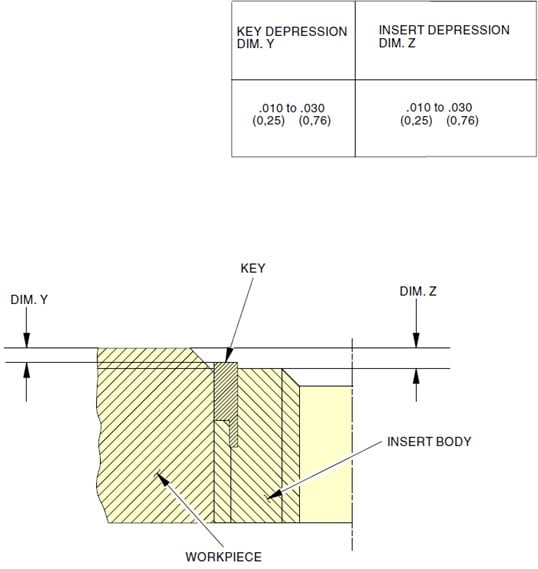
- Ensure insert flange sits within specified surface depression limits.
- Drive the keys fully below the insert surface using an installation tool.
Oversize Insert
- Screw the insert in until keys naturally align with the housing.
- Key alignment determines correct insertion depth.
- Use an installation tool or soft-faced punch to drive keys fully.
- Confirm that keys are correctly recessed below the surface.
5. Final Inspection and Cleanup
| Inspection Item | Requirement |
|---|---|
| Insert seating | Flush or slightly recessed |
| Keys seating | Fully driven below insert surface |
| Surrounding material | No raised metal, cracks, dents, or distortion |
| Thread quality | Free of tears, burrs, or metal transfer |
Remove any excess sealant and clean the surrounding housing or mounting surface.
Frequently Asked Questions
What is the biggest difference between standard and oversize Boeing inserts?
Oversize inserts are only used when a previous repair has enlarged the tapped hole. They require drilling, and re-tapping before installation.
Why does Boeing specify depth-controlled installation?
Keys must be fully recessed below the surface to avoid interference with mating parts, protect against wear, and preserve structural integrity under cyclic loading.
Can the Pro-Tool be used to install beneath the surface?
Yes the Pro-Tool is designed to drive the keys under the surface one operation with controlled depth, supporting consistent, spec-compliant installations across common aerospace materials.